 Andy Bennett
Dreaming of transforming your backyard into a personal sanctuary? An outdoor hot tub can be the centerpiece of that dream, offering a warm, inviting haven for relaxation and connection. But with so many options, the path to your backyard oasis can feel overwhelming. You’re likely worried about choosing the wrong type, hidden costs, or the dreaded maintenance.
As someone who’s spent years testing and reviewing every kind of spa imaginable, I’m here to cut through the confusion. This guide will walk you through everything you need to know about outdoor hot tubs, from the different types and their costs to placement and upkeep, so you can buy with total confidence.
What Are the Main Types of Outdoor Hot Tubs?
Choosing the right type of outdoor hot tub is your most important first step. Each style comes with its own unique set of pros, cons, and costs that can dramatically shape your experience. Before you dive in, consider your budget, the space you have available, and your long-term goals for your backyard retreat.
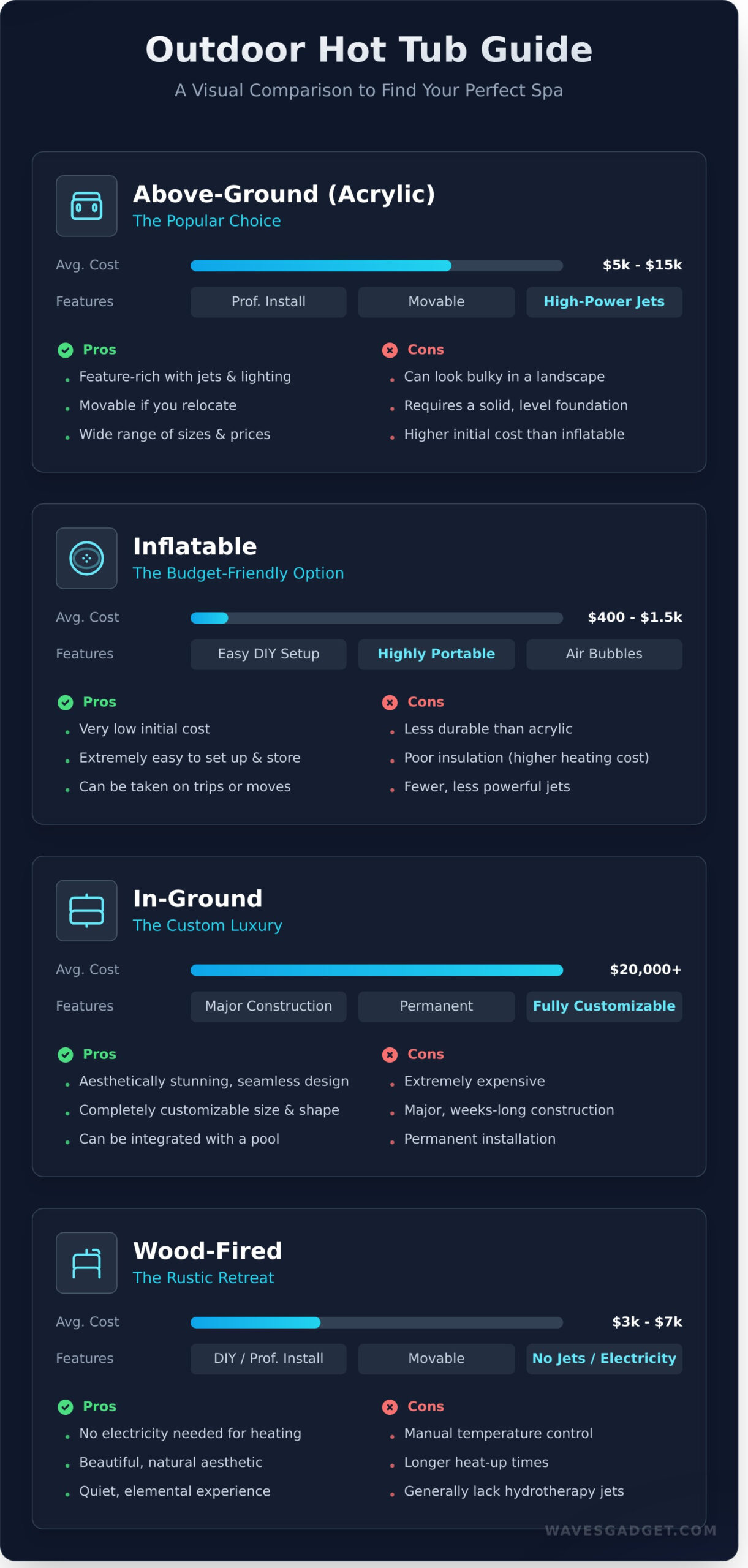
To make it easier, we’ve broken down the four main categories.
| Feature | Above-Ground (Acrylic) | Inflatable | In-Ground | Wood-Fired |
|---|---|---|---|---|
| Price Range | $4,000 – $20,000+ | $400 – $1,500 | $20,000 – $50,000+ | $3,000 – $8,000 |
| Installation | Professional delivery, simple setup | DIY, very easy | Professional, complex construction | DIY or professional, moderate |
| Portability | Movable (but difficult) | Highly portable | Permanent | Movable (when empty) |
| Features | High-end jets, lights, audio | Basic bubble jets | Fully customizable | None (natural heating) |
| Best For | The classic, feature-rich experience | Beginners, renters, or small budgets | A seamless, luxury landscape design | Off-grid living and a rustic aesthetic |
Above-Ground (Acrylic) Hot Tubs: The Popular Choice
When you picture a classic outdoor hot tub, you’re likely thinking of an above-ground acrylic model. These are self-contained units that arrive pre-assembled and are relatively easy to install.
- Pros: They are packed with features like powerful hydrotherapy jets, LED lighting, and even built-in sound systems. Because they aren’t permanent fixtures, you can take them with you if you move. The market is huge, offering a very wide range of prices and styles.
- Cons: Their size can make them look bulky in a small yard. Most importantly, they require a perfectly solid and level foundation, such as a concrete slab or a specially reinforced deck, to support their immense weight when filled.
Inflatable Hot Tubs: The Budget-Friendly Option
For those wanting to dip their toes into the hot tub world without a major investment, an inflatable hot tub is the perfect entry point. These portable spas offer surprising comfort and relaxation for a fraction of the cost.
- Pros: The low initial cost is the biggest draw. They are incredibly easy to set up—often inflating in minutes—and can be deflated and stored away during the off-season or when not in use.
- Cons: Durability is a key trade-off; they are susceptible to punctures. Their insulation is far less effective than acrylic models, leading to higher heating costs, and the “jets” are typically air blowers that create bubbles rather than providing a true hydrotherapy massage.
In-Ground Hot Tubs: The Custom Luxury
Built directly into your landscape, an in-ground hot tub offers a seamless, resort-like feel. These are custom-built spas, often paired with an in-ground pool, and are the pinnacle of backyard luxury.
- Pros: The aesthetic appeal is unmatched, as they can be finished with stone, tile, or other materials to perfectly match your patio and landscaping. Every aspect, from size and shape to jet placement, can be customized to your exact specifications.
- Cons: This luxury comes at a steep price, making them by far the most expensive option. The construction process is lengthy and disruptive, and once it’s built, it’s a permanent part of your property.
Wood-Fired Hot Tubs: The Rustic Retreat
Embracing a simpler, more natural approach, wood-fired hot tubs provide a unique, off-grid soaking experience. They use a small wood stove to heat the water, creating a rustic ambiance that’s hard to beat.
- Pros: They don’t require any electricity, making them ideal for cabins or remote properties. The natural aesthetic of wood blends beautifully into any outdoor setting, and the quiet operation (no pumps or blowers) offers a truly peaceful soak.
- Cons: Temperature control is entirely manual and requires practice to get right. They also take significantly longer to heat up compared to their electric counterparts.
7 Key Factors to Consider Before You Buy an Outdoor Hot Tub
Thinking ahead is the best way to save yourself time, money, and future headaches. Before you get swept away by fancy features, use this checklist to plan your perfect outdoor hot tub setup and ensure you make a choice you’ll love for years to come.
1. Location and Foundation
Where will your new hot tub live? You need a spot that is perfectly level and structurally sound enough to support several tons of weight. For most acrylic spas, this means a reinforced concrete slab or a heavily reinforced deck. You’ll also want to consider privacy from neighbors, proximity to your house (a short dash in the cold!), and a clear delivery path. Crucially, measure the entire path from the street to the final location, including gates and corners, to ensure the spa shell can get through.
2. Size and Seating Capacity
Think realistically about how many people will be using the hot tub at once. A giant 8-person tub might seem great, but if it’s usually just for two, you’ll be paying to heat a lot of empty water. Tubs come with different seating styles, from open bench seating to form-fitting lounge seats that let you fully recline. Remember, a bigger tub isn’t always better for your energy bill.
3. Electrical Requirements: 120V vs. 240V
This is a critical technical detail.
- 120V “Plug and Play” Models: These plug into a standard outdoor outlet. They are simpler and don’t require an electrician, but their heaters are less powerful. This means they heat the water very slowly and typically cannot run the heater and the jets on high at the same time.
- 240V Models: These require a dedicated circuit installed by a qualified electrician, which is an added cost. However, their powerful heaters bring water to temperature much faster and can easily run the jets and heater simultaneously, which is essential for cold-climate use.
4. Jets, Pumps, and Hydrotherapy
Don’t fall into the trap of thinking more jets equals a better massage. The quality, type, and placement of jets are far more important than the sheer number. Look for a variety of jet types (rotating, directional, pulsating) that are targeted at key muscle groups. The power of the pump is what determines the force of the massage, so ensure it’s properly matched to the number of jets for effective hydrotherapy.
5. Insulation and Energy Efficiency
Good insulation is the single most important factor in keeping your running costs down. Full-foam insulation, where the entire interior cabinet is filled with spray foam, is significantly more effective than simple thermal wrap or fiber-based insulation. Just as important is a high-quality, tight-fitting hot tub cover. Most heat loss occurs through the water’s surface, so a well-insulated cover is non-negotiable for energy efficiency.

6. Water Care and Maintenance Systems
Every outdoor hot tub requires regular water chemistry checks to keep it safe and clean. While traditional chlorine or bromine systems are effective, many modern tubs offer advanced water care systems to simplify the process. Look for options like ozone generators or UV sanitizers. These systems help neutralize contaminants, which can significantly reduce the amount of chemicals you need to add manually, but they don’t eliminate chemical use entirely.
7. The True Cost of Ownership
The sticker price is just the beginning. To avoid surprises, be sure to factor in the total cost.
- Upfront Costs: Delivery fees, foundation prep (e.g., pouring concrete), and electrical work for a 240V connection.
- Monthly Costs: Budget for chemicals, replacement filters, and the increase in your electricity bill (this can range from $30-$75+ per month depending on your climate, tub size, and insulation).
- Warranty: Always ask about the warranty. A good warranty will have separate coverage for the shell structure, acrylic surface, and major components like pumps and heaters. Ensure you understand what is covered and for how long.
Ready to find the perfect model? We’ve tested dozens to find the best performers.
> See our top-rated models in our expert outdoor hot tub reviews.
Frequently Asked Questions
How much does it cost to run an outdoor hot tub monthly?
On average, expect to pay between $30 and $75 per month for electricity and chemicals. This varies widely based on your climate, the tub’s insulation, your electricity rates, and how often you use it.
Can you use an outdoor hot tub in the winter?
Absolutely! Soaking in hot water while surrounded by cold air and snow is a magical experience for many owners. The key is having a well-insulated tub and a high-quality cover to maintain temperature efficiently.
How long do outdoor hot tubs typically last?
A well-maintained, quality acrylic hot tub can last anywhere from 10 to 20+ years. Inflatable models have a much shorter lifespan, typically 2 to 5 years.
Do I need a building permit for a hot tub?
This depends on your local regulations. Many areas require a permit, especially for the electrical wiring or if you’re building a new deck or concrete pad to support it. Always check with your local building authority first.
Is it hard to maintain the water in a hot tub?
It requires consistency, but it’s not difficult once you learn the basics. A simple routine of testing the water a few times a week and adding chemicals as needed usually takes just a few minutes.
What’s the difference between a hot tub and a Jacuzzi?
“Hot tub” is the generic term for a spa. “Jacuzzi” is a specific brand name that pioneered the industry, much like Kleenex is a brand of tissue. While all Jacuzzis are hot tubs, not all hot tubs are Jacuzzis.